Monday, January 17, 2011

Desalinization Breakthrough


Our readings of texts like Stewart's Earth Abides, McCarthy's The Road or Callenbach's Ecotopia have sharpened our awareness of the necessity of water and the fragility of the infrastructure that delivers it to our faucets.
Today, much of the news is consumed with our decreasing oil supply and the potential crises resulting but the human body does not require petroleum products for survival - we survived for millennia without it. However, water is central to human survival and a mere 7-10 days without water would kill most people by dehydration.

Published in 1863,  "The Rime of the Ancient Mariner" by Samuel Taylor Coleridge has left us with a line that many of us have heard and repeated:

"Water, water, every where,
And all the boards did shrink;
Water, water, every where,
Nor any drop to drink." 


While they almost seem cliche, with these lines Coleridge left us with an important reminder of a significant fact about life on earth: 97.5% of the water on Earth is not drinkable without reverse osmosis desalination processing which is very expensive and maintenance intensive according to a United Nations Environment Program Report:"...significant costs associated with reverse osmosis plants, aside from the capital cost, are the costs of electricity, membrane replacement, and labor." 

 Though reverse osmosis is the predominant technique for desalinization, there are several other desalinization processes used today. One of the most recent and most promising approaches to desalinization called "forward osmosis" is being developed at Yale.

For more info, listen to Living On Earth's report "Low Salt Water with Low Energy Technology."

Monday, November 22, 2010

Walking in Circles

"walking in circles" by angrytoast

 When we went on our Corbin Cabin retreat, one of our skill sessions was about map reading and cross-country navigation. Most hikers use topographic maps to find and follow various marked trails, but sometimes the view you want to see is off the trail and you need to "bushwack" or hike cross-country off trail. If the distance is short, this is no problem, but when humans walk long distances cross-country we tend to walk in circles.

And we're not sure why.

In a recent NPR story "A Mystery: Why Can't We Walk Straight?"
Robert Krulwich interviews Jan Souman, one of the co-authors of "Walking Straight Into Circles" published in the August 2009 issue of Current Biology.  In blindfold experiments run on various topographies from the Saharah Desert to the Bienwald forest in Germany, subjects invariably ended up walking in circles.


 During our Corbin Cabin retreat we addressed one way to avoid such circling using map and compass. For example, if we wanted to bushwack from Corbin Cabin to Camp Ridge Trail, first we would lay the edge of our compass on the map so as to connect the cabin with the point we want to hit on Camp Ridge Trail. Next, we would turn compass housing or outer ring of the compass so the underlying red orienting arrow lined up with the compass needle pointing North. On some compasses this gives us the direction of travel in degrees, but even without them, the hiker can stay oriented. Holding the compass so that the orienting arrow arrow aligns with the North (red) end of the compass needle, you will be faced toward the goal. By choosing a series visible landmarks like notable trees, large rocks or other obvious features that are directly in line with the direction of travel arrow, the hiker can travel in a relatively straight line to the chosen destination and avoid ending up walking in circles. The success of this involves stopping to realign the orienting and magnetic North arrows at each landmark to re-orient to the goal before choosing the next landmark.

To accomplish this, the hiker must be a close observer of detail on his compass, his map and his terrain.  Such close reading is also important in literary studies where interpretive moves require attention to detail and occasional re-orientation. For example, our literary "bushwack" might involve using our reflective compass to trace a line connecting narrative events that are not directly connected by the writer. In Cormac McCarthy's sobering novel The Road we might wish to connect the occasional but disconnected geographic details and descriptions McCarthy gives to see if we can recognize and identify the specific route the characters take.
Wesley Morgan of the University of Tennessee does this in his hypertext "The Route and Roots of the Road" where he tracks these details, landmark by landmark, to reconstruct the route and locates it in the southeastern US.

For more detailed instructions about map and compass orientation see Kjetil Kjernsmo's illustrated guide on how to use a compass or Princeton's excerpt on map and compass work from The Backpacker's Field Manual by Rick Curtis.

Monday, November 15, 2010

Chesapeake bayside camping trip

Our most recent camping trip was in early October at First Landing State Park in Virginia Beach where the first English settlement was established in 1607, from which Captain John Smith explored the Chesapeake Bay.

An advance crew left early on Friday and got camp set up but the second wave got caught in traffic and then I missed an exit after the CBBT so our arrival was delayed a bit, but when we arrived we were welcomed enthusiastically.


 Lodge vet Parker Hawkins started the fire, and we set up the remaining tents and got the kitchen started so we could have dinner (spaghetti al Rubino) with fireside s'mores for dessert....


...while we circled the fire sharing jokes, stories and even a little dancing.


Our campsites were near the road but still in the dunes and under the shade of the beautiful sprawling Live Oaks native to the area.


The weekend weather was superb and after some early morning review of knife, saw and axe safety we headed for the beach.


The sand was littered with horseshoe crab shells, seaweed and mermaid's purses, and the winds kept my kite flying high.


With huge container ships anchored in the distance and the inspiration from a pod of dolphins that playfully frolicked nearby, several intrepid Lodgers spontaneously formed what looked like a group of playful pagan sea goddesses doing a ritual dance complete with horseshoe crab crown and mermaid's purse rattles. They were impressive, but I think they scared the crap out of those poor guys playing bocce on the sand.


Such spontaneous play is an important but increasingly rare activity in our often over-scheduled, "productive" lives. The good news is that it's free and we can tap into the surprising power of play any time we want to.
(I wouldn't cross 'em, would you?)

Playfully building on the collaborative skills developed during our Corbin Cabin retreat, our Chesapeake bayside weekend turned out to be a much-needed stress-buster and a delightful success.

Tuesday, September 7, 2010

Getting to Know Your Neighbors


"Hello black gum tree. It is nice to meet you. I hear you are one of the first trees to change color in the fall. I look forward to seeing that!" I enjoyed seeing old friends and meeting new ones today on our plant walk around Westhampton Lake. "Hello willow oak, sycamore, tulip poplar, river bird, beech, sweetgum and so many more! And you, sassafras, would you have chosen such a fun name on your own? I shall visit you soon for a tea date." Talking about the names of trees on campus today reminded me of a passage from Twelve by Twelve, where author William Powers writes, "Sociologists point out that American kids today can identify a thousand corporate logos but less than ten native plants and animals that live around their homes." He goes on to wonder, "are we, like Gold Kist [a giant poultry production company] chickens evolving in artificially manufactured, rather than natural, ways?" (44). At first glance, the idea that kids can identify so many logos and so few natural things is a bit horrifying. But the more I think about it, it makes sense. We didn't lose the ability to recognize patterns and use our powers of observation, we just use them differently than a hunter-gatherer culture. We pay attention to what is important in our lives. Instead of learning the land and knowing the plants and the animals and transmitting the tribal oral history, we know how to use computers, relate to popular culture, do well in school, keep up with the national and global news, get around the city, buy food and navigate the complexities of modern life. I do not think these are lesser achievements. In fact, an indigenous person might be in awe at the amount of stress the average person endures just to live a modern life. They might also think it is ridiculous.

I don't think being a modern, savvy person is a bad thing, but I worry that when we get so caught up in this manufactured lifestyle we overlook the fact that our human world is built entirely upon the natural world. We forget that the principles that govern the natural world also govern us and our creations and you get the big global mess we are in right now.

Maybe what we are doing in our sit spots is reacquainting ourselves with the principles of the natural world, slowly reeducating ourselves to something we once collectively knew before human hubris took over. Sitting in this one spot, we get to see the constant dance of life and death and the great interconnectedness of all things. Slowly we start to realize that we are just a part of that. As I look around, I cannot help but be filled with gratitude for being a part of this world. I am smiling at the plants around me now. Can they feel me relax and let my heart open?
-Geoff Cox

ASSIGNMENT FOR THIS WEEK: In addition to your journal, discover the name of one tree and one bird on campus that you do not already know using the resources on blackboard (Supplements>Relevant Links>Online Field Guides). Draw and label a picture of both the bird and a leaf from your tree. Use as much detail as possible and include any distinguishing marks or characteristics that aided your identification. Include everything someone else would need to know to identify the species without seeing it directly.

If you are trying to discover the identity of a bird but are not able to be sure what it is for whatever reason (e.g. seeing it briefly in bad lighting), write down everything you can think of that you observed about the mystery bird.

Monday, September 6, 2010

Sense of Place in the Western Desert by Tara Laidlaw


Hello friends! Here is an entry from my friend Tara, who you met in class and on the plant walk. Sections in quotations are from the journal she kept while in Australia with the Martu, an Aboriginal family group in the Western Desert---

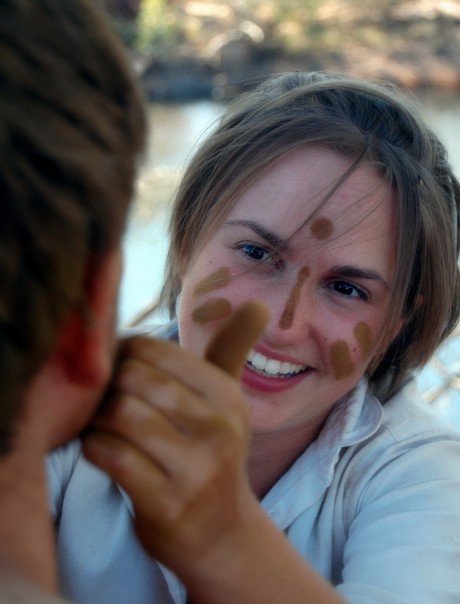
Several years ago, I had the extraordinary honor of spending a week with an Australian Aboriginal family group on their land title in the Great Sandy Desert of western Australia, learning as a participant observer in one of the few remaining hunter-gatherer societies on the planet. This week was the culmination of a seminar about indigenous Australia taught by two Stanford professors who had been instrumental in fighting in court for the Martu – an Aboriginal cultural group – to get their land legally restored to them. The relationship between the professors and the Martu made it possible for 14 students not only to visit the land title but also to stay there for a week and learn from the Martu in traditional ways.

Picture Above: Tara (bottom, with hat) helping pluck a desert turkey

What struck me the most was the incredibly deep connection the Martu have to the land on which they live. Every aspect of life is governed by this land: food and drink; spiritual beliefs; sleeping arrangements; songs; stories; dances; play; interpersonal relationships; coming-of-age ceremonies; death rites. This vast interconnectedness within the culture and to the land gave rise to a staggering sense of time-depth as I learned more and more about these peoples’ lives.

"These people have lived on this land in this way for tens of thousands of years. Doug [one of the professors] was saying too that that vast history is reflected in Dreamtime [spiritual] stories: for example, there are stories that have been handed down through the generations about giant carnivorous kangaroos, and those kangaroos did used to live in Australia – 30,000 years ago."

This is an example of a piece of information about the landscape as it was 30,000 years ago, now reflected in a spiritual creation story – pretty amazing! Nancy, the elder who held the land on which we were staying, called this kind of information “old memory.” As the holder, her responsibility is to

Picture to Left: Lizard (parnajalpa/sand goanna) in the foreground; desert turkey (kipara) in the background (feathers all over the ground and the carcass spread over a spinifex plant just to the right of the shovel)

keep track of this sort of knowledge that catalogues the stories about the land, its features, its inhabitants, and the changes it undergoes through time. This information was presented both to the next generation of Martu children and to the Stanford students alike through Dreamtime stories, dances, and songs, just as it had been taught to the current group of elders. Even though today’s Martu children straddle their parents’ world and the encroaching white world, they still grow up with the same cultural underpinnings and the same remarkable connection to the land as their parents and grandparents have.

"The kids grow up in such a different way [than most children I know] – a month in Parnngurr [the outstation] for every week out at Kurta-Kurta [the field camp], pulling water from a soak via a windmill and sleeping under the most spectacular sky I’ve ever seen, setting fires in extremely flammable material and eating lizard and camel and kangaroo that they’d caught earlier that day."

The children also learn about the hunting and gathering traditions that play a major role in the Martu lifestyle. Children learn by observing their elders and at a young age are capable of pulling witchetty grubs from trees; tracking lizard, kangaroo, and desert turkey; and identifying and collecting roots and tubers. Even at a young age, a child is expected to bring in the majority of his or her own calories. While a small child isn’t going to be going out hunting with a gun, to successfully bring in that much food requires enormous attention to detail. This attention to detail is a learned skill: children not only follow along during hunting and gathering expeditions led by adults but also play traditional games that encourage close observation. They certainly have a leg up because this skill set is so highly prized (and necessary!) in their culture, but the skill is developed and sharpened throughout childhood and on into adulthood.

"After digging for ganjimarra [tubers] in a dry riverbed (you find the plant and then excavate the root, straight down, until the whole thing is exposed and you can pull it out without breaking it) we got distracted at a white tree that was full of lungki [witchetty grubs] – Brianna and Alicia [Martu girls aged about 10 years] were up the tree armed with axes before I knew what was going on, and after only maybe 20 minute there was a ziplock bag full of squirmy gooey grubs."

Picture to Left: Children pulling witchetty grubs (lungki) out of a hole in a tree using a twig. The kids made it look easy, but the grandmas laughed while the Stanford students tried (and failed) to hook the grubs with the end of the stick and pull them out.

Like most Aboriginal groups, the Martu relate spatially to the world in an absolute fashion rather than in a relative fashion. This means that there are literally no words in their language for right or left, or front or back, for example. Instead they use directions – north, south, east, west – acknowledging their position within the landscape as a whole and using unmoving reference points rather than relying on a single individual’s own perception of his or her place in the landscape. So when asked where someone wants to lay the fire, for example, the response isn’t “over to the left of the trucks” but rather “to the south of the trucks” – and that is equally clear to everyone, regardless of where they’re standing in relation to the trucks.

This way of relating to the world isn’t limited to the adults. From a very young age, children hone their own skills as expert navigators. While this is easier for these children because it’s an integral part of their culture, it’s not in-born. It’s a learned skill, just like tracking and collecting food. I once saw a mother ask her son to point to where his grandma lived. We were out in the middle of the desert and I couldn’t have pointed to where we’d parked our truck a few hours back, let alone where our base camp was, but the child pointed without hesitation in a particular direction. His mother then adjusted his pointing by a few degrees – that precise! – and said, “That’s where your grandma lives.”

It can be tempting to paint indigenous Australians as nature-lovers, living in perfect harmony with each other and never disrupting the world around them. This can be pretty far from the truth, especially when their culture comes into contact (and conflict) with white culture. But even when on their own land title where they’re most comfortable, the Martu certainly have a major impact on the landscape: they use extensive fire management to promote a diversity of food sources, make it easier to track game, and keep plant reproduction at a steady and predictable rate. If they were to leave the landscape alone and just take what they could find without the creating a burn mosaic, they would have a vastly harder time finding enough to eat and would have to move base camp locations much more frequently. So while the Martu do move lightly on the earth (particularly in comparison to what I’m used to as an American), they also manipulate the landscape to suit their own needs, and have been doing so for long enough that the landscape now depends upon their presence.

With that said, though, spending that week with the Martu was an remarkable lesson in living simply and turning to the land as an unendingly generous source of life, if only you know how and where to look. So while it was spectacular fun to hunt and swim and hear stories and eat weird things in the desert, the real take-home message was about deep observation, true gratitude, and the value of paying very close attention to the world around you.

-Tara Laidlaw

Also, in case anyone is interested, the two professors who led the trip have websites with information about their research:

Doug Bird: http://www.stanford.edu/~dwbird/DWBIRD/main.html

Rebecca Bliege Bird: http://www.stanford.edu/~rbird/RBIRD/main.html

Rebecca has brief and (relatively) understandable summaries of the different research projects she and Doug are working on with the Martu; both have links to their publications, many of which are about the Martu and some of which are available as pdfs. These tend to be pretty dense but if anyone is really into it they might be worth a look.

Further reading & viewing:

The Mardu Aborigines: Living the Dream in Australia’s Desert, Robert Tonkinson, 1986.

Pintupi Country, Pintupi Self: Sentiment, Place, and Politics Among Western Desert Aborigines, Fred R. Myers, 1978.

Rabbit Proof Fence, 2002.

10 Canoes, 2006.

Wednesday, September 1, 2010

Settling in at Your Sit Spot

7:30am

Who in the world is making that chattery noise outside my window? It seems to be the same time every morning. I carefully peak out the window, attempting not to disturb whatever is making the noise. The first thing I notice is a bird frantically hopping around the fig tree outside my window chattering away, twitching and looking this way and that. But what bird would use so much energy and draw so much attention to itself? It looks like a cardinal but the coloring is all wrong...oh wait, it is a juvenile, of course! This late in the summer and still sounding like a begging fledgling? The subtle movement of a branch farthur up reveals the father, bright red, and yet still less conspicuous than the youngster. He is calm and aware, looking after his child. He alternates between calculating scans for danger and cleaning his beak on the bark. He snatches up a small caterpillar in an instant.

But where is his mate? Dead? Cardinal pairs have an intense bond and will spend the year together hardly ever out of sight or chirping distance, usually until one of them dies. Maybe this silly adolescent is all the male cardinal on my fig tree has left. After a long summer of feeding and caring for 2-4 broods and losing his mate, this one juvenile might be all he has left. All the others have either left their nesting territory or more likely did not survive the summer. In North America, 70-90%(depending on who you ask) of perching birds don't make it to adulthood. Between the nest robbers like crows, jays, squirrels, raccoons and snakes and bird eaters like foxes, some hawks, and owls, this adult male must have developed intense awareness and survival skills. It is hard to be a bird.

Suddenly he looks up and flys off. The juvenile does not notice for quite some time and then flies after its father in a panicked flight. With that level of awareness, it may never live to have a red beak. I look outside. The mourning dove is still feeding in the weed garden. The carolina wren is still singing from the hedge and the starling is giving its syncopated verbalization from the top of the post. What made the cardinal fly off? Did he just spook prematurely, without any real danger? No, he probably would not have lived through a summer of raising young if he used up his energy overreacting and misjudging. He must have noticed me peering at him through the window. Despite his ninja-like awareness, he will probably not live more than a few years even though cardinals can live up to 15 years in the wild if they are not killed.

All this drama, and what is funny is that if you walked by in the heat of the day, or weren't really paying attention, you would probably wonder if any birds even lived here...
-Geoff Cox
Settling in at your Sit Spot
By this coming Tuesday (7th), you should be have found the sit spot that you are going to commit to for the semester. Whether discovering a new sit spot or returning to the one you found last week, use this week to start to feel a little more at home. Remember that your sit spot practice starts the moment you leave the door to go to your spot.
Sense Meditation: Take a deep breath and exhale, releasing the tension in your body and your mind. Soften your visual focus to settle into the "wide-angle" vision we explored at Corbin Cabin. Allow your eyes to relax, not focusing on any one thing and becoming more aware of movement in your periphery. Notice how your ability to detect motion is greatly enhanced. Expand your hearing 360 degrees around you, listening for the quietest sound on campus. Taste and smell the air. Feel your body, your feet on the ground, your breath. Relax and smile. With this relaxed yet hightened awareness, wander to your spot. Can you get in the mindset of heading in a direction but being in the moment every step along the way?
This is not always easy. When thoughts arise, smile at them and just let them come and go. Don't push them away or hold on to them. Allow your thoughts to just be part of the landscape of observation. Notice the thoughts arising and passing like clouds in the sky or the sudden flight of a startled bird. If you have trouble doing this, notice that too. If this is a struggle and thoughts of self-judgement start to arise, just notice those too, smile at them and let them go. The key is to be gentle with yourself.
Map: In addition to spending 20-30 minutes sitting silently at your spot, spend some time mapping the area around your spot in a 15-step radius. This time you can map while you are there. Bring a 8.5 x 11 sheet of paper and draw the area around you in as much detail as you can. Notice how many kinds of plants, trees or critters you see. Put them on the map even if you don't know their name. Feel free to give them a name. Really look at the plants and trees around you. Challenge yourself to study some of them close enough that you could draw a leaf or branch from memory. Maybe try to draw one or two from memory in your journal. Feel the dirt in your fingers. Label North on your map, even if you aren't exactly sure.

Monday, August 30, 2010

Pony Pasture Plant Walk


On Sunday morning a small group of fearless Lodgers joined together for a walk along the river to learn some of their plant neighbors. Lee led us around the familiar paths of Pony Pasture, stopping every once in a while to introduce us to one of the locals. No longer do we have to walk by the spicebush, the hackberry, the redbud, the wild grape, the sycamore or box elder without noticing them or knowing how to acknowledge them.

Now we can say, "hi river birch!" not as a way to define or control, but as a first greeting, the beginning of a relationship. Now that we have met them, I start to wonder, "why didn't I say hello sooner? What was so important that I never stopped to learn the names of my neighbors or see how they were doing or marvel at their seasonal displays of aliveness?" I realized that many of these trees were here long before I was and will be here long after. Even stinging nettle has a sweet side. Although painful to touch, a boiling bath will render the hairs painless and allow for a nutritious tea (high in iron!) or bite to eat.

And I can't forget the nutritious and delicious fruit from the paw-paw tree. This time of year, the fruit is becoming ripe. It is best when squishy to the touch and has a taste somewhere between a mango and a banana. Here is a picture of Paul savoring its sweetness.
In addition to meeting some of the local plants, we also noticed the tracks of some of the local animals. After tracking the elusive Sarah across the sand, we started looking around to see what other animal tracks we might find. Nikki spotted the prints of a raccoon in the mud while we crossed a pipeline bridge.


Towards the end of the walk, Paul noticed some more raccoon tracks, and he tracked it to the water's edge where it bent down to drink. He also helped solve the mystery of a female deer who had walked through the stream. Ask him how we knew it was a female.